Public sector wages in South Africa: An analytical view

Public sector wages have been a point of contention in the South African economy for many years. In July 2012, government and its employees, reached an agreement which stipulates that the annual increase received by public sector workers between 2013 and 2015 will be inflation plus 1%.
CPI+1%=Wage Increase
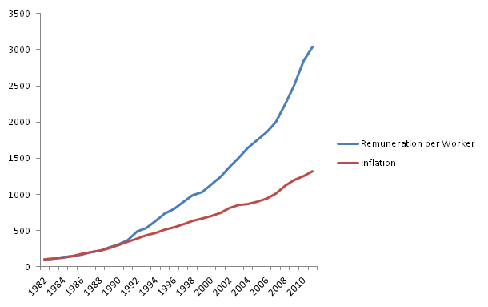
This negotiation represents a victory for the negotiation process as it allows government to budget accordingly, in advance until 2015. Figure 1 contains an index that indicates the annual increase in public sector per worker remuneration from 1982 to 2011 and the inflation rate for each year. The correlation coefficient between public sector wage increases and inflation over this time has been 0.574314301 with wages increasing on average by 3.24 percentage points per year. This is more than the inflation rate over this period.
In Figure 1, it can be seen that the indices which represent public sector remuneration per worker and inflation, were moving together in a fairly uniform manner until 1991. From 1992 onward there is a noticeable explosion in remuneration per worker in comparison to inflation showing that real wages have experienced a sharp rise between 1992 and 2011.
Figure 1: Public sector remuneration per worker (nominal) and inflation (base:1982=100)
*Source: South African Reserve Bank and Stats SA
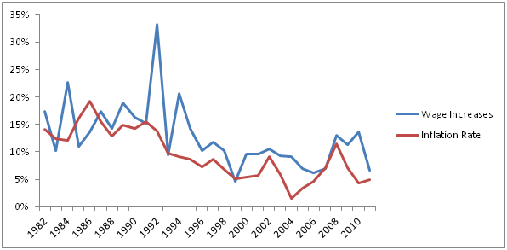
In Figure 2, we can see that generally over this period of time, inflation has been below the public sector wage increases with a significant spike in remuneration per worker in 1992.
Figure 2: Public sector wage increases and inflation rates
*Source: SA Reserve Bank and Stats SA
Figures 1 and 2 clearly show that public sector wage increases have increased at a rate above inflation. In effect this agreement has seen to it that the above inflation increases demands, which have become the norm (and led to strike action) over the past two or three years, will be capped at 1% above inflation. This introduces an element of stability to both labour and employer (government).
Although this negotiation represents a marked improvement in employer/employee relations in the public sector, the issue of sustainability should not be over looked. If real wages increase by 1% per annum over an extended period of time without a direct increase in productivity, the public sector wage bill to government expenditure ratio will deteriorate.
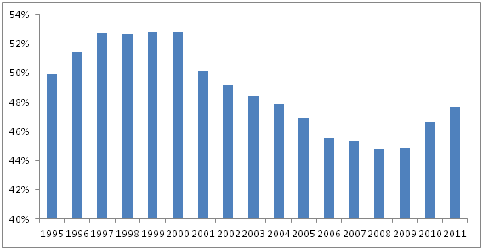
Figure 3 shows the government wage bill as a percentage of total government expenditure (including state owned enterprises). This ratio has shown great improvement between 2000 and 2008 (decreased by 7.9 percentage points) but has been on the rise since 2009. Unless the agreed increases are matched by increased productivity, this ratio could be expected to grow even further due to increased unit labour costs. A salient feature is the stability which results from the reduced number of expected strike days due to the agreement which will play a role in the improvement of productivity as fewer work days will be lost.
Figure 3: South African public sector wage bill / government expenditure
*Source: SA Reserve Bank
On the other hand, the guaranteed inflation plus 1% increase must be well managed or else the employees may feel that regardless of their efforts, they will receive the same annual increase and therefore reduce their productivity.
Conclusion:
The South African Government, as the largest employer of staff in the economy, has shown control in reeling in their wage bill to expenditure ratio between 2000 and 2008. However, since 2009 this ratio has been on the rise again as a result of high inflation plus wage agreements. Government’s agreement with labour, of a guaranteed inflation plus 1% increase, constitutes a significant effort to once again halt rises in this ratio but it must be managed effectively (in order to maintain performance levels). If production levels are improved through the avoidance of mass strike action, this agreement could set the tone for future agreements and make SA’s wage bill to government expenditure ratio competitive with those of other emerging economies.
 |
Chris Blair is the CEO of 21st Century Pay Solutions Group (Pty) Ltd. He has a B.Sc in Chemical Engineering from Wits University. He has been endorsed for his skills in organisational design, performance management, talent management, organisational development, HR consulting, change management, employee engagement, remuneration and leadership development. Contact him on This e-mail address is being protected from spambots. You need JavaScript enabled to view it. . |
 |
Bryden Morton has a B.Com (Hons) economics and is data manager at 21st Century Pay Solutions Group. |